Personal-Model-First: Why Elephant Agent Self-Evolves Around You

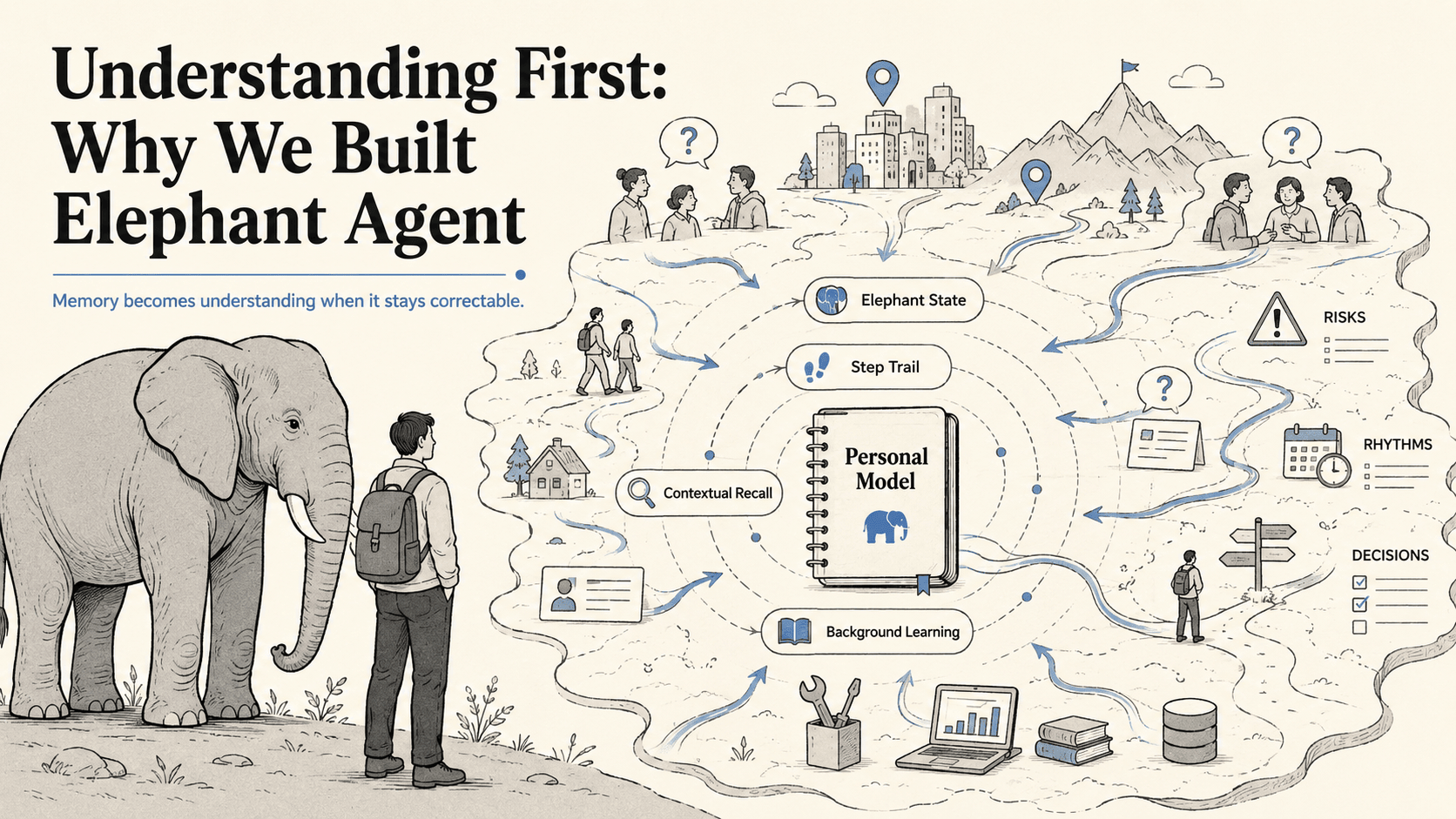
Elephants never forget, but the interesting part is not storage.
An elephant does not remember like a hard drive. It remembers like a living being. Its memory is social, emotional, spatial, survival-aware, and practical. It recognizes members of the herd by sight and smell. It remembers danger cues. It returns to important places long after the last visit. It carries the difference between a safe path, a risky signal, a trusted companion, and a dry season that should not be repeated.
Older matriarchs make this visible. A remembered drought is not a line in a database; it is judgment the herd can move with. Elephants can recognize other animals and humans after years apart. Their hippocampus links emotion to long-term memory. Their cerebral cortex supports problem solving, cooperation, tool use, and quantity tracking. They communicate across distance, comfort each other, protect the young, and respond to loss with a tenderness that makes memory feel close to care.
That is the inspiration for Elephant Agent: not an AI with more memory, but an AI whose memory can turn lived context into better judgment.
The first wave of personal agents is learning two useful things. Memory matters. Skills matter. A personal AI should be able to recall what happened, and it should become more capable over time.
But neither is the center.
Raw recall answers: what can be retrieved from the past?
Skills answer: what can the agent do?
Personal AI needs a third object at the center: what does the agent currently understand about the person, and how can that understanding be corrected, deepened, or questioned?
Elephant Agent is built around that object. We call it the Personal Model.
Memory Becomes Understanding
If a personal AI stores every transcript, it still may not understand you.
It may retrieve the wrong old snippet. It may over-trust something you have changed your mind about. It may treat a joke, a temporary mood, or a stale project as durable truth. It may remember a sentence without understanding why that sentence should matter tomorrow.
Skill evolution has a similar limit. An agent can learn useful procedures, install better tools, and automate more surfaces. That is valuable. But a personal agent that evolves capabilities without evolving understanding becomes capability-first: better at acting, not necessarily better at helping you.
Elephant Agent makes a different bet:
Personal AI should evolve around a correctable Personal Model first. Memory, skills, tools, models, cron, messaging, and UI should orbit that model.
This is the difference between a recall layer and an understanding system.
Raw recall retrieves. Elephant Memory Architecture decides what should become a claim, what should stay evidence, what should expire, what should be asked, and what should be safe to use in the next answer.
In other words, memory is not downgraded to recall. Recall is one layer inside the system. Elephant Agent treats memory as a full architecture for turning experience into judgment.
The Personal Model
The Personal Model is not a hidden profile. It is not a longer prompt. It is not a vector database with a nicer name.
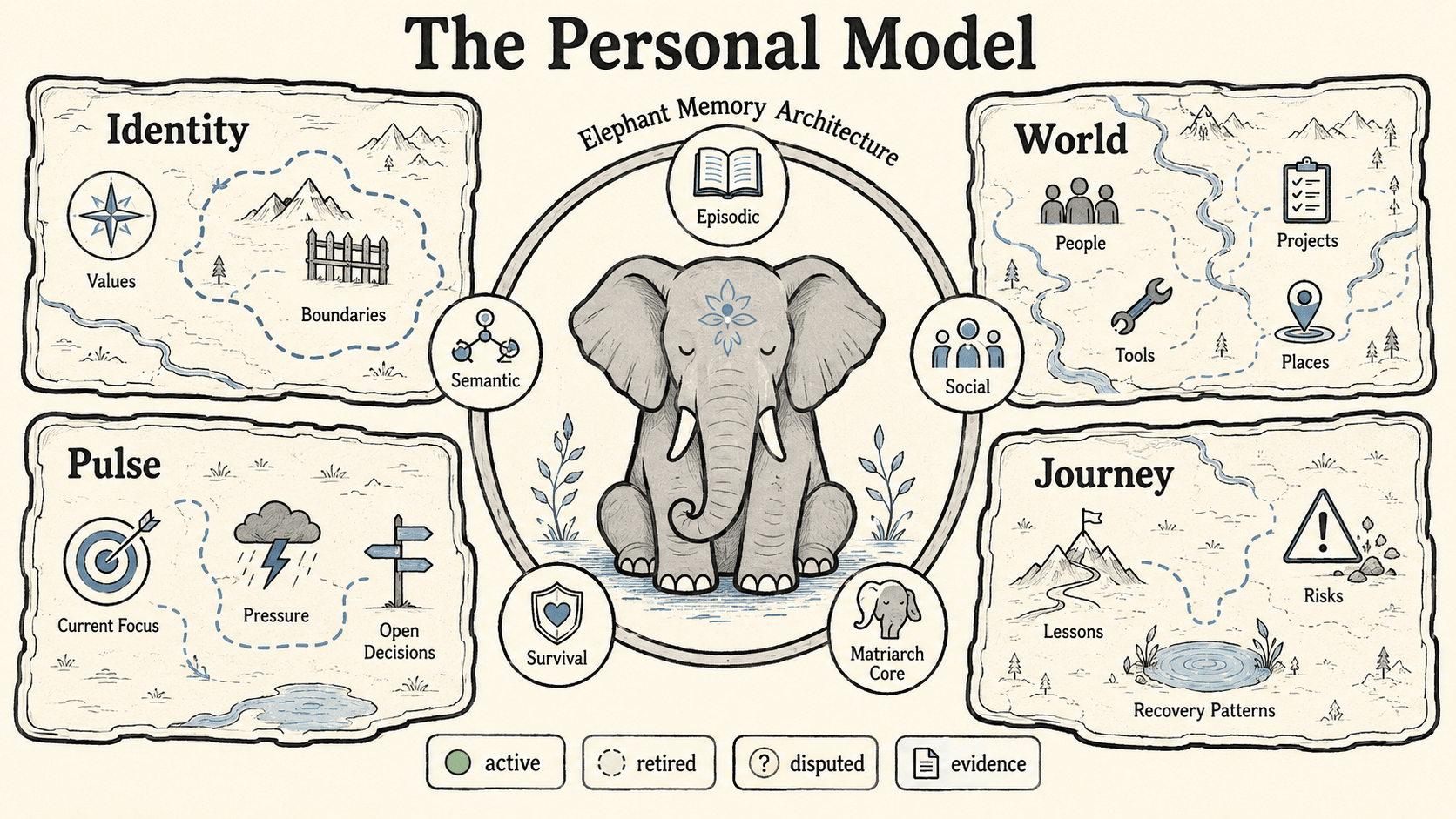
It is the explicit, inspectable center of Elephant Agent's continuity: active claims, open questions, status, confidence, and provenance. Each claim belongs to one of four lenses.
Identity asks: who is this person?
It carries durable self-description: name, language, values, boundaries, decision style, stable preferences, communication taste, and the kind of help that usually lands well. Identity changes slowly. When it is wrong, correction matters more than accumulation.
World asks: what and who surrounds them?
It carries people, teams, projects, repositories, tools, places, vocabulary, obligations, recurring meetings, domains, and stable constraints. World is how Elephant Agent stops treating every request as if it arrived from nowhere.
Pulse asks: what is alive right now?
It carries current focus, open decisions, active pressure, recent blockers, temporary priorities, and mood or energy patterns when the user has made them relevant. Pulse is deliberately fresh. A stale Pulse claim should be easy to replace.
Journey asks: what has the path already taught?
It carries lessons learned, repeated risks, recovery patterns, past decisions, direction changes, and long-running growth. Journey is how Elephant Agent helps without making you pay the same explanation tax after every reset.
The durable unit is a claim, not a transcript sentence. A claim has a lens, topic, text, status, confidence, and source episode provenance. Only active claims enter the stable prompt. Retired and disputed claims remain inspectable, but they do not shape future answers.
Within a lens, Elephant Agent uses facets as stable topic keys. A facet is
not a survey field; it is the naming layer that keeps one claim attached to the
right slice of understanding, such as world.skills.affinity.python,
pulse.current_focus, or journey.lessons.debugging. This lets search and
correction operate on claims instead of ambiguous profile blobs.
This is intentionally smaller than a profile and deeper than a chat log.
The elephant-inspired memory model maps onto the runtime as five layers:
- Episodic memory lives in Episodes, Loops, and Steps: what happened, when, and through which operation.
- Semantic memory lives in typed Personal Model claims: durable principles, preferences, lessons, and context.
- Social memory lives in World claims and supporting Steps: people, teams, projects, collaborators, and relationship context.
- Survival memory lives in Pulse and Journey claims: risks, repeated failures, pressure patterns, and recovery paths.
- Matriarch Core is the Personal Model plus curiosity and background learning: the place where evidence becomes judgment.
Curiosity Is the Learning Loop
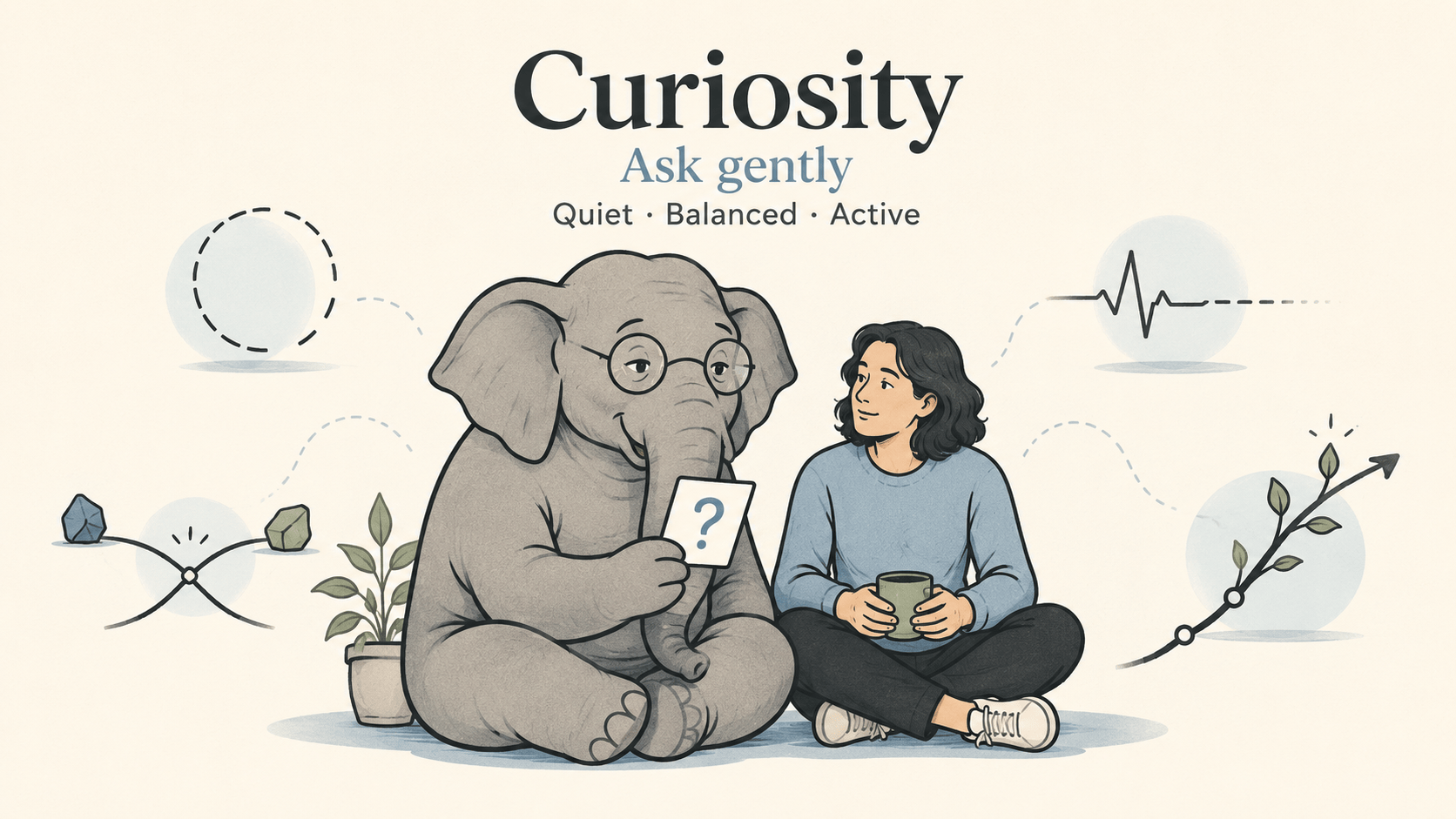
Most memory systems are passive. They wait for the user to say something, then try to store or retrieve it.
Elephant Agent needs a more living behavior: it should notice when its understanding is missing, conflicted, stale, or too vague to help.
That is what we mean by proactive curiosity.
Curiosity is not interrogation. It is not a survey. It is not hidden profiling. It is a bounded maintenance loop for the Personal Model. Elephant Agent may ask one useful question when the answer would change future help.
Questions are typed. Each one has a lens, topic, reason, priority, sensitivity, and lifecycle: open, asked, answered, dismissed. A question exists for one of four reasons:
- a gap where important understanding is missing,
- a conflict where evidence no longer agrees,
- a stale Pulse where current context likely expired,
- an adaptation where one answer would materially improve help.
The user chooses the effort level: quiet, balanced, or active. Silence is honored at every level. When a question is answered, the answer can become a Personal Model claim through the same update path as any explicit correction.
This is why curiosity is central to the product. Personal AI should not only remember what was said. It should maintain the relationship between what it believes and what would help next.
From Philosophy to Runtime
The architecture is designed to protect that distinction.
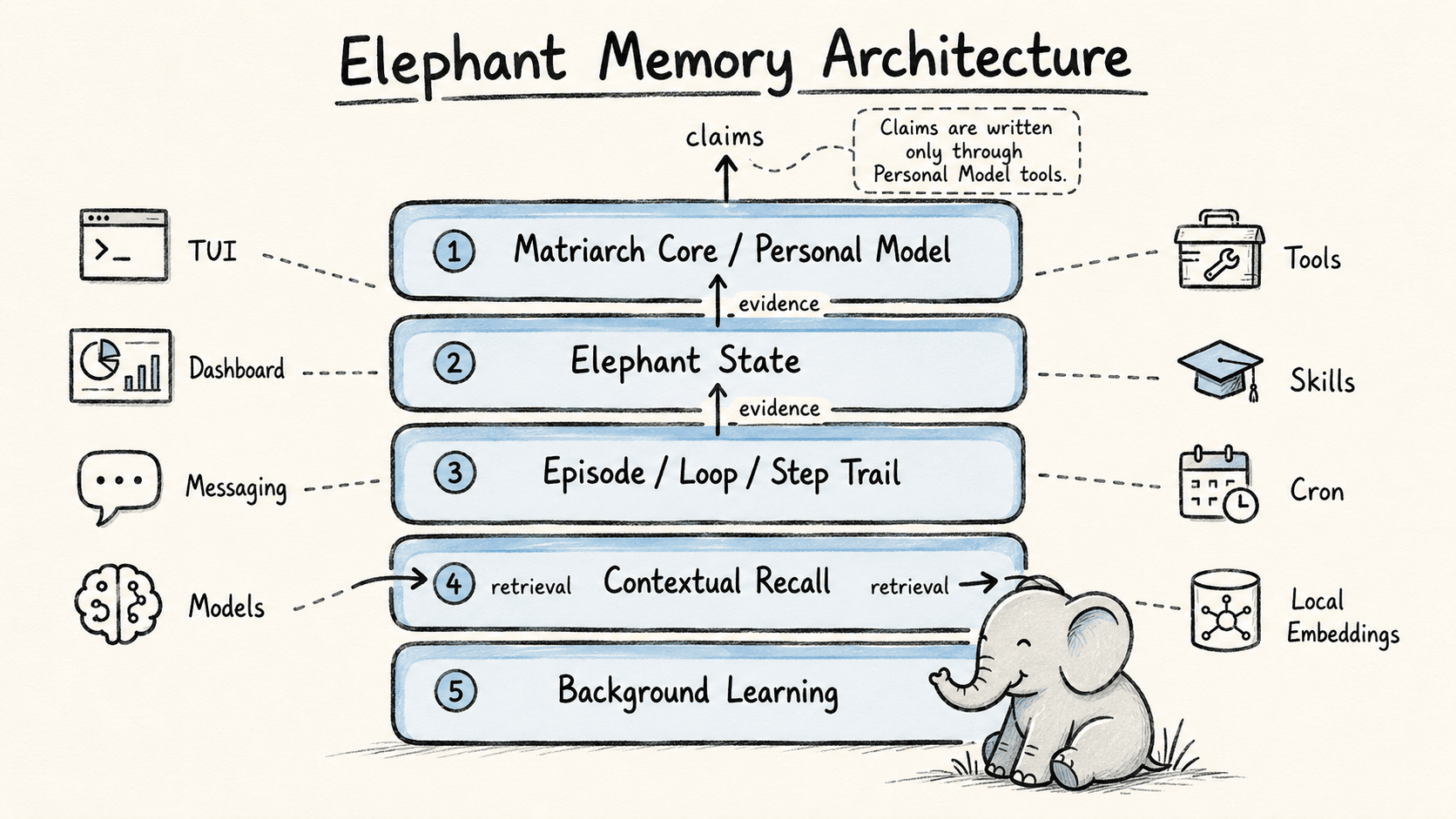
Matriarch Core / Personal Model is the durable understanding layer. It owns Identity, World, Pulse, Journey, and open questions. If something should shape future answers, it belongs here, with provenance and a repair path.
Elephant State is intentionally small. It identifies the active elephant and keeps one natural-language context note: where this elephant should resume.
Episode / Loop / Step Trail is the lived trace. An Episode is one runtime window. A Loop is one model interaction round. A Step is one atomic event: input, reply, tool call, tool result, recall support, or Personal Model update. Steps are evidence. They are not automatically truth.
Contextual Recall is the retrieval layer of Elephant Memory Architecture. It finds supporting material for the current turn or a reflect job. It can search Personal Model facts and conversation Steps, but retrieved material is support. It does not become a durable claim unless a foreground update or background learning job writes it through the Personal Model.
Background Learning lets Elephant Agent learn after the turn. Episode close, manual reflect, diary, dream, and context-compaction triggers compose specific features and tools. A reflect agent receives an evidence packet, calls allowed Personal Model, question, diary, or skill tools, and writes its result into the learning job record.
The important design rule is simple:
Prompt text is a projection of state. It is not the owner of truth.
Claim-Aware Recall
This is where Elephant Agent differs from generic vector memory.
When Elephant Agent searches its Personal Model, it is not searching a pile of notes. It is searching active claims. The retrieval unit is the claim, and the claim has a lens, topic, status, confidence, and evidence trail.
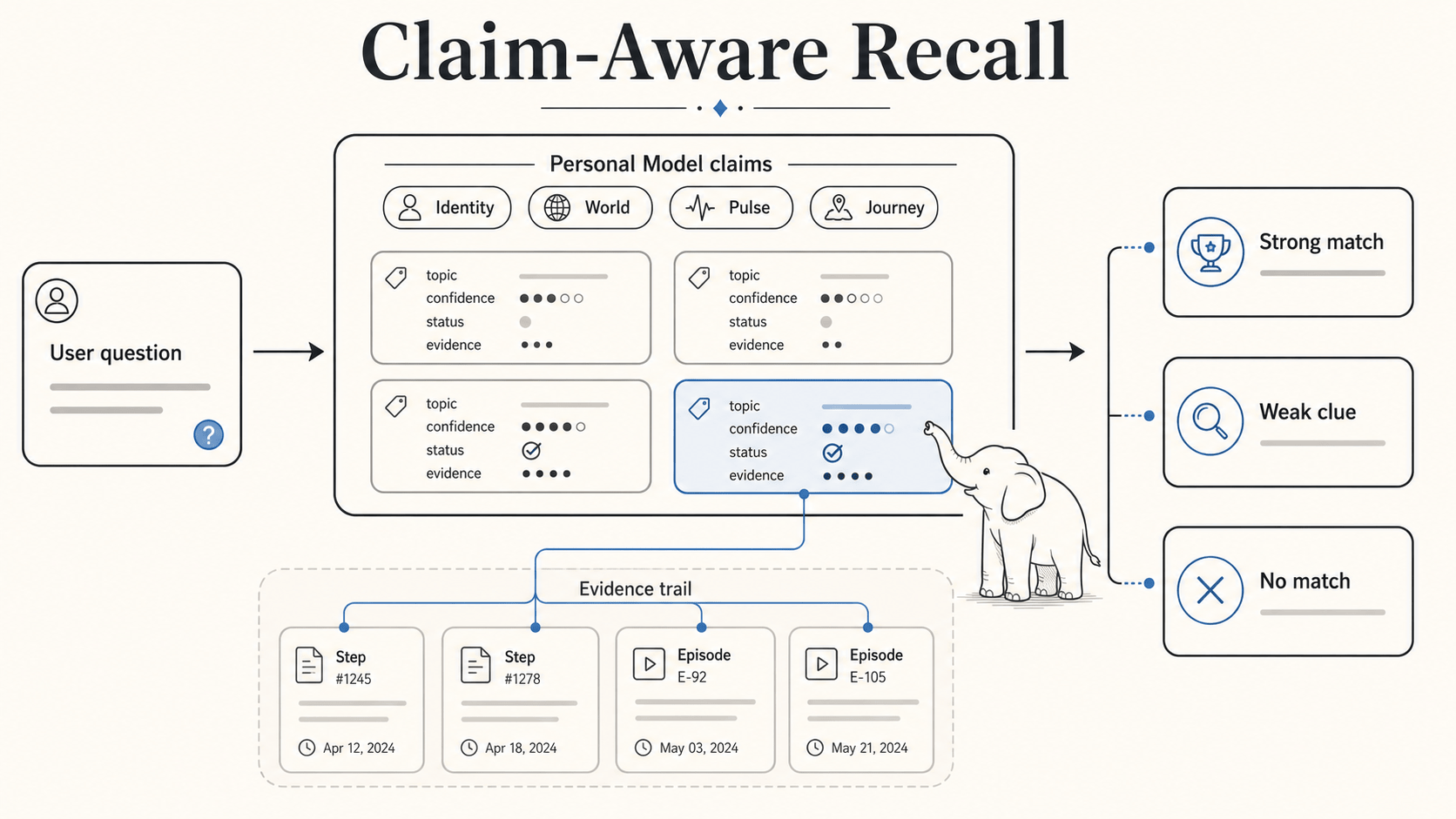
Search combines several signals:
- topic keys and topic prefixes,
- exact claim text and source-support matches,
- Unicode lexical matching and CJK n-grams,
- weak fuzzy matching for spelling or character variation,
- semantic candidates from the durable index,
- translated or paraphrased
query_variantssupplied by the model, - freshness signals for claims that should decay.
The result includes a match status:
strong_matchmeans the agent can rely on the claim.weak_matchmeans something is relevant but should not be overstated.no_matchmeans the Personal Model does not support the answer.
no_match is not a failure. It is a safety behavior.
Without this, memory systems drift. A nearest neighbor becomes a belief. A similar old sentence becomes personalization. A stale fact becomes confidence. Elephant Agent keeps the boundary visible: recall can support the current turn, but durable understanding stays in claims.
Multilingual, Hybrid, Time-Aware Search
Good personal memory is not just semantic similarity. It is judgment.
People do not remember by asking one database for the nearest sentence. We remember through a richer judgment: what was said, who said it, whether it is still true, whether the wording changed, whether it happened recently, whether it belongs to a stable identity or a temporary mood, and whether the memory is a belief or only a clue.
Elephant Agent brings that judgment into recall search.
The algorithm is multilingual because real personal context is multilingual. One person may explain a project in English, correct a preference in Chinese, name a file in code, and later ask for the thread in a mix of all three. Elephant Agent does not depend on one brittle keyword form. It can follow meaning across mixed wording, translated variants, and language boundaries without turning language matching into a hidden alias table.
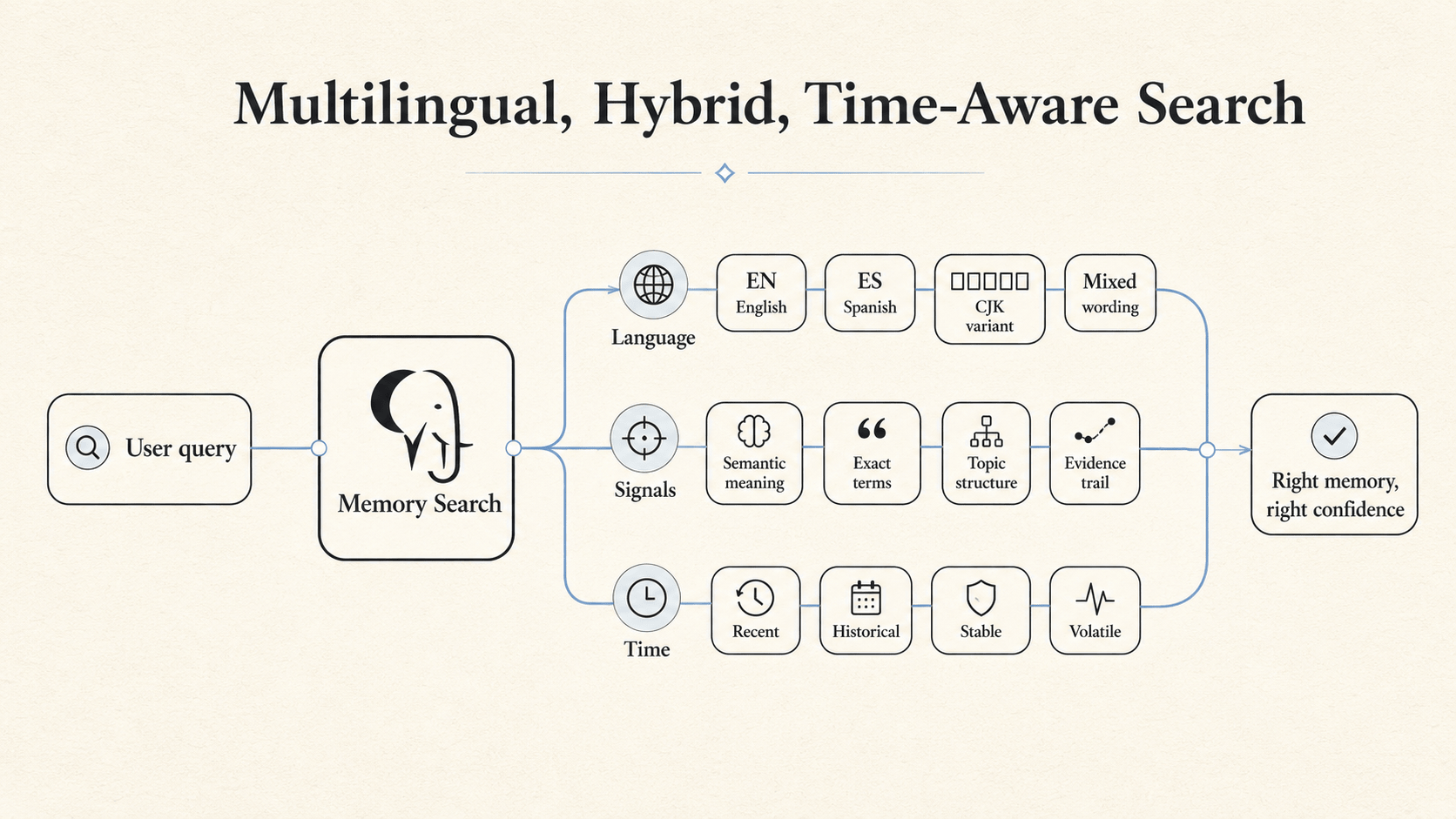
It is hybrid because no single signal deserves to be trusted alone. Semantic search is good at meaning, but weak at exact commitments. Keyword and BM25-style signals are good at names, dates, tools, and concrete phrases, but brittle when the wording shifts. Topic structure is good at narrowing the Personal Model, but it should not make an irrelevant claim look relevant. Elephant Agent fuses these signals so recall can stay both flexible and grounded.
It is time-aware because personal truth has different half-lives. I was tired this week should not age like a birth date. This project is active should not age like a permanent preference. A phrase like last night or recently is not decorative text; it changes what kind of memory should be searched and how much recency should matter.
The result is not a longer archive. It is a better way to decide whether the agent has found a durable claim, a weak clue, a conversation trail, or a visible gap where it should not pretend to know.
This is the practical bridge between elephant memory and personal AI:
recover the right path, in the right language, at the right moment, with the right level of certainty.
Local Semantic Recall
The local embedding path exists to support that boundary without turning personal context into a remote analytics stream.
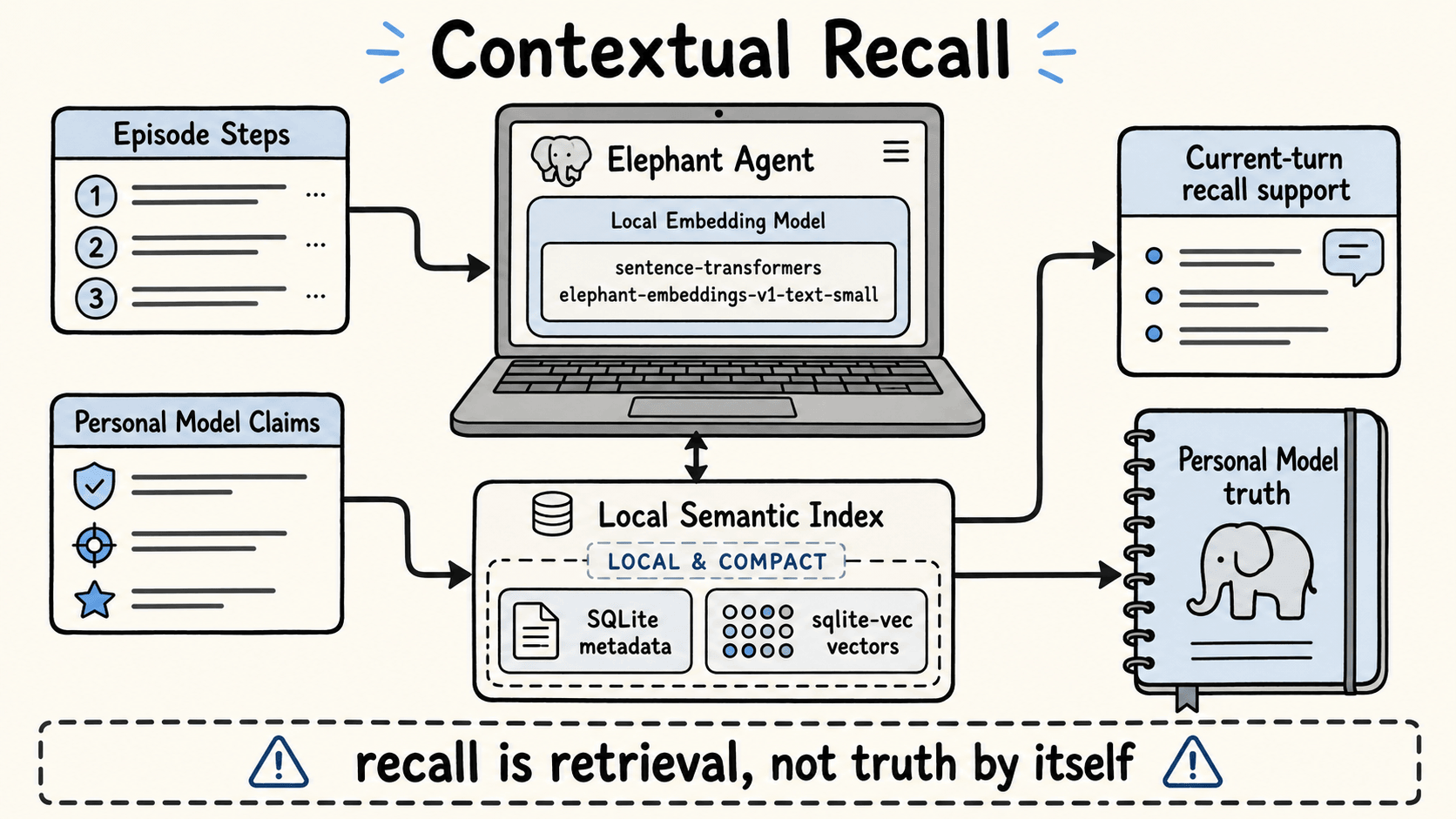
Elephant Agent's default embedding provider is elephant-local-embed, backed
by elephant-embeddings-v1-text-small. The runtime loads the model from the
local Elephant Agent model root with sentence-transformers and
local_files_only=True. If the local model root is not ready, the provider
reports health as pending or downloading instead of silently falling back to a
remote path.
The embedding model supports three online dimensions:
- 64d for fast everyday recall,
- 256d as the balanced default,
- 768d for deeper semantic search.
The implementation uses normalized embeddings and a Matryoshka-style truncation path: a larger source representation can be truncated to the selected online dimension and normalized again. That lets one compact local model support different latency and depth postures.
The semantic index has two parts. Metadata rows live in SQLite as
SemanticIndexEntry: owner scope, source item, provider, model, dimensions,
content hash, status, and provenance pointers. Vectors live behind a
sqlite-vec backend when available. If vector indexing is degraded, the
metadata still records the state, and lexical search can continue to help.
That gives Elephant Agent a practical local recall stack:
- foreground claim writes are indexed immediately,
- Step and Fact chunks can be embedded locally,
- vector search is fused with lexical and keyword signals,
- matches point back to their source items,
- recall support remains support, not truth.
This is the technical reason the product can say "correctable understanding" instead of "memory." The system can show what it found, what it believes, and where the two differ.
Background Learning
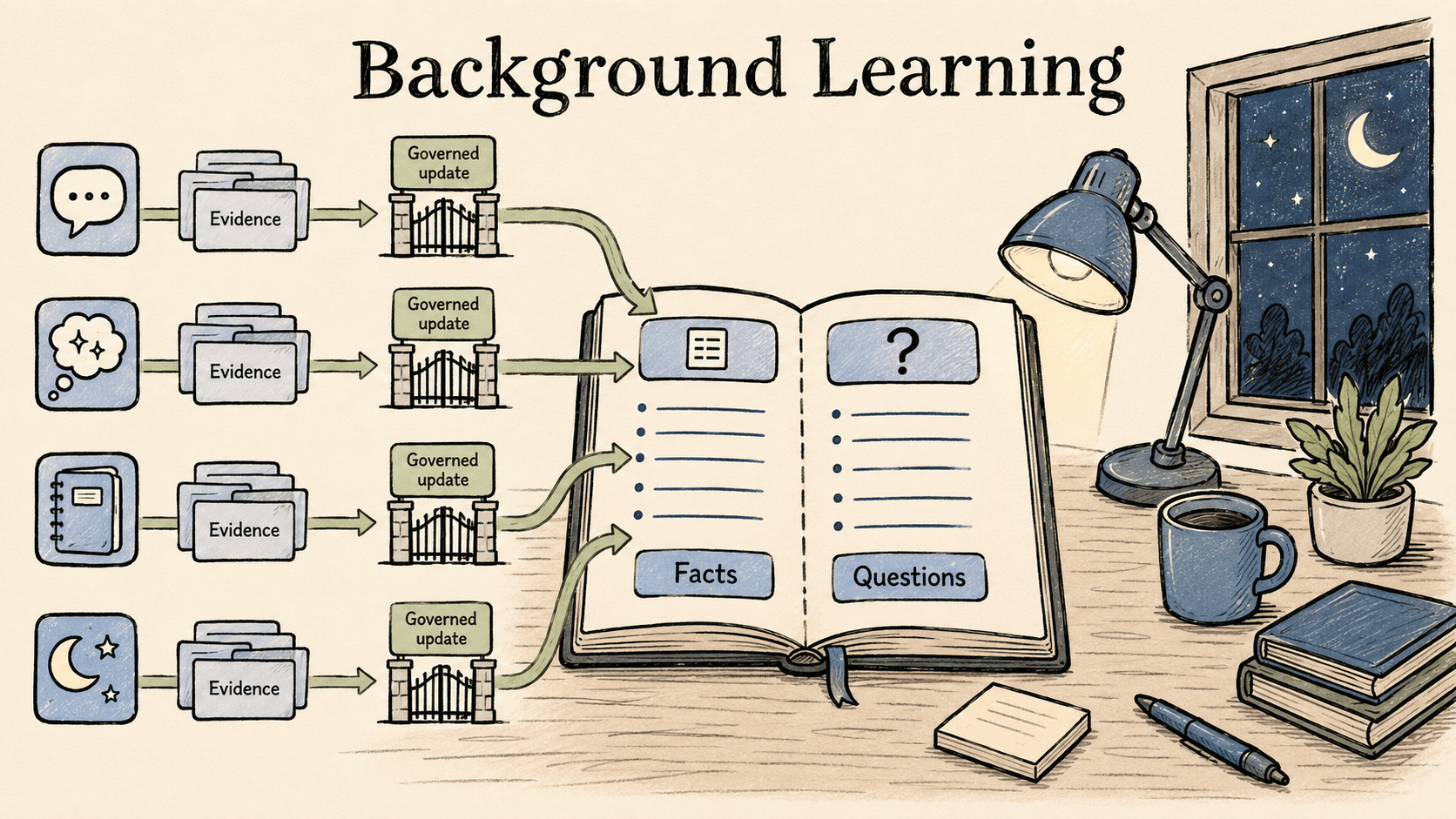
Foreground conversation should help now. It should not stop every few turns to perform maintenance on the user's entire understanding graph.
Elephant Agent moves that work into feature-composable background learning.
Different triggers activate different feature sets:
- Episode close can run Personal Model, question, and skill maintenance.
- Manual reflect can add recall support.
- Diary writes a reflective entry for a day.
- Dream can combine broader question, skill, and diary maintenance.
- Context compaction checks compressed material without turning it into prompt truth.
Each reflect job receives an evidence packet built from active Personal Model anchors, Episode summaries, and conversation turns. The reflect agent is given only the tools its features allow. It writes facts, questions, diary entries, or skill notes through the same governed surfaces as the foreground agent. The job result records what happened.
There is no hidden "memory proposal" layer in the clean design. Steps are the evidence. Facts are the durable understanding. Learning jobs are the lifecycle that decides when evidence should change understanding.
The Operator Surface
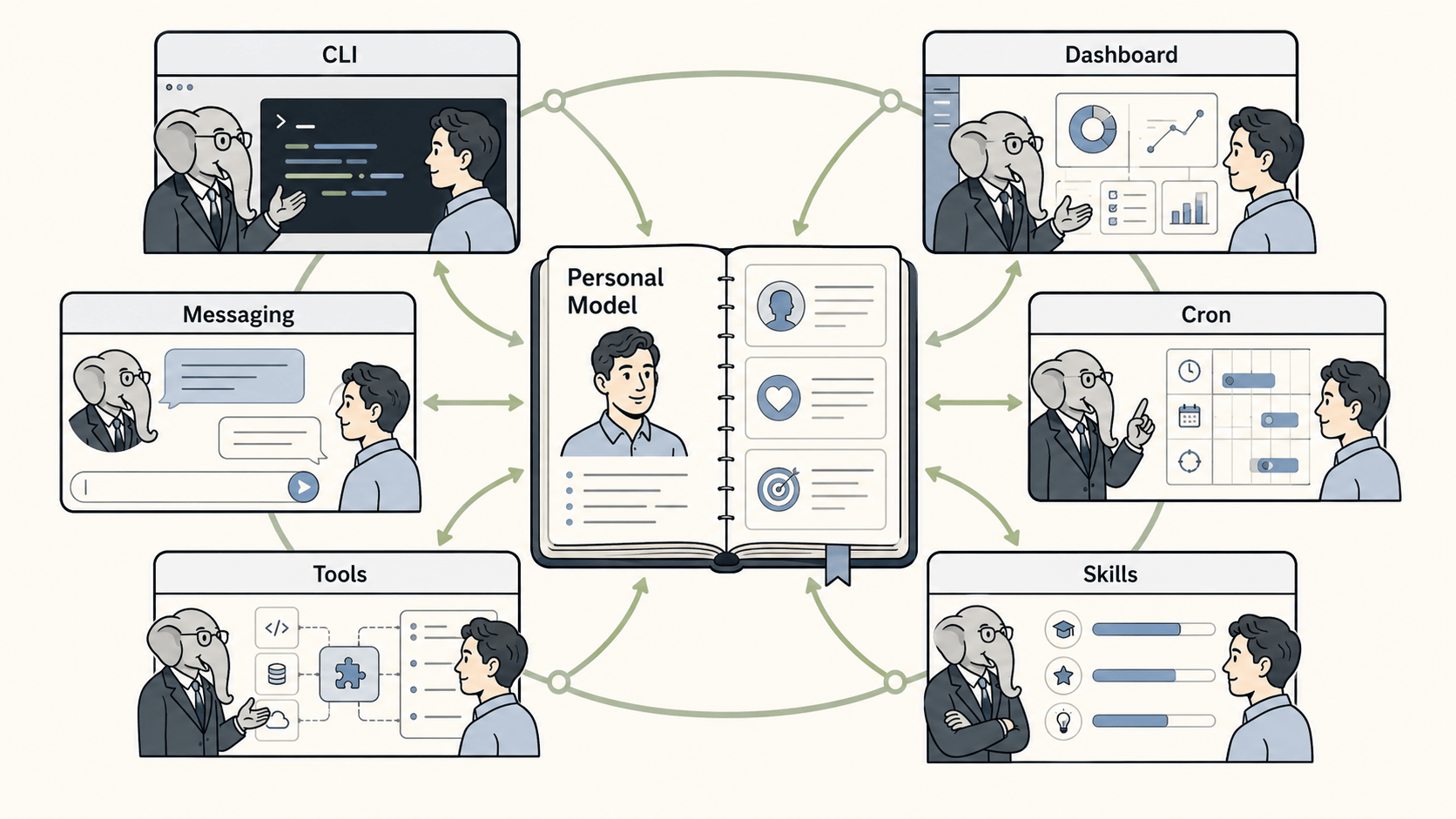
Elephant Agent is not only a paper architecture. It has to be lived through ordinary surfaces.
The CLI creates and wakes an elephant. The chat TUI is the fast daily path. The Dashboard shows Personal Model claims, questions, evidence, jobs, providers, logs, and herd state. Messaging bridges let the same elephant meet you outside the terminal. Cron jobs let background work happen on a schedule. Tools and skills remain visible capabilities rather than hidden personality changes.
This is also why the project is open source. If an AI is going to grow an understanding of you, the persistence model, learning jobs, question lifecycle, local inference path, and repair operations should be inspectable.
The Core Bet
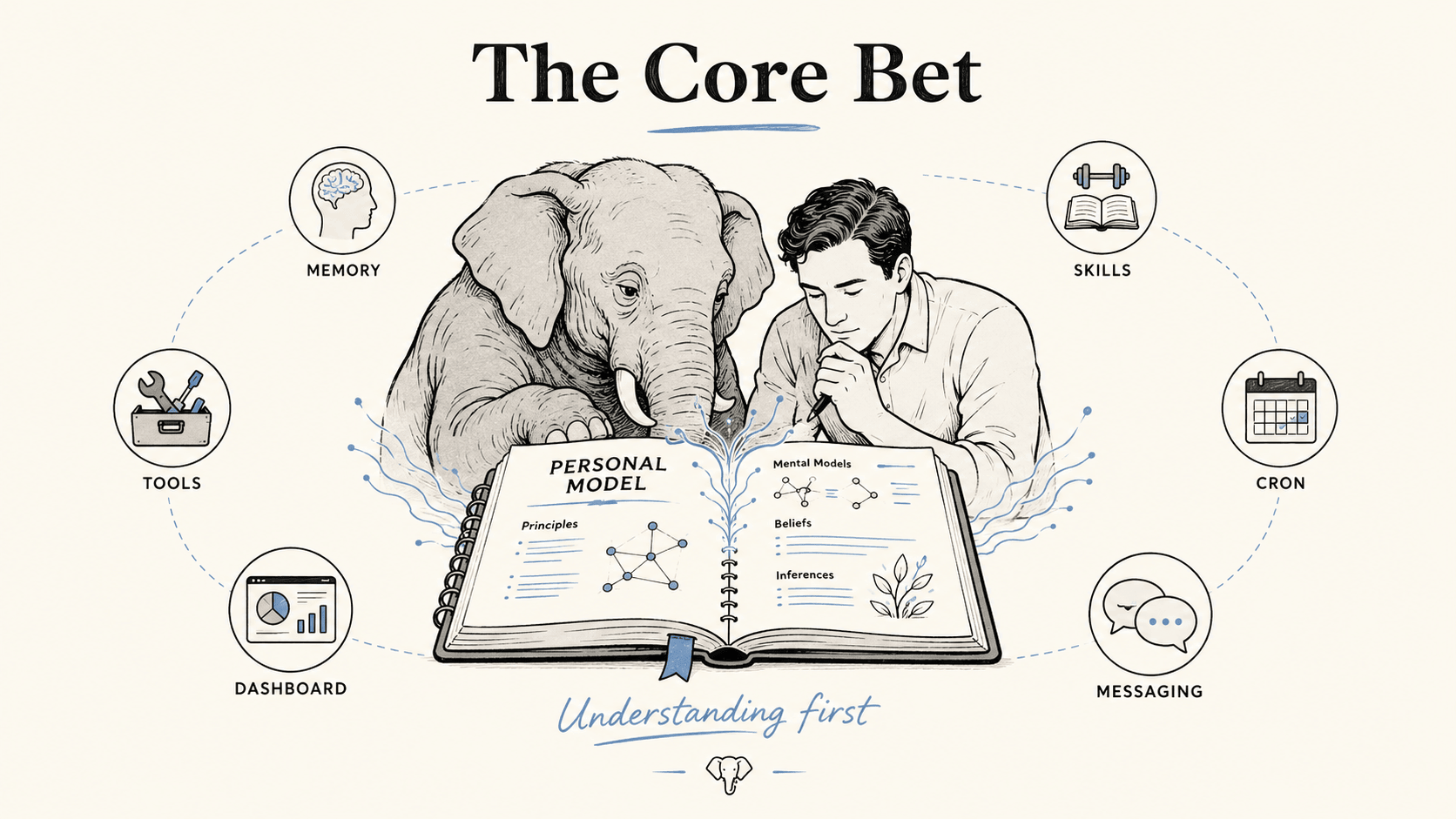
The next generation of personal AI will not be won by the agent with the longest transcript or the largest skill shelf.
It will be won by the agent that can maintain a living, correctable model of the person it helps.
Elephant Agent is our first version of that bet:
Personal-Model-first. Self-evolving through curiosity and reflect. Correctable as it grows.
Memory helps. Skills help. But personal AI starts when the system can ask: what do I understand, why do I believe it, what is missing, and how should this change the next answer?
What Comes Next
The next step is to make that understanding deeper, safer, and more capable without losing the center.
We want background learning to do more than notice skill matching. When the same useful pattern appears across real work, Elephant Agent should be able to propose a new skill or improve an existing one, with the evidence visible and the final shape still yours to accept.
We also want the security boundary to become as inspectable as memory itself: stronger coding sandbox isolation, clearer tool access control, safer background jobs, and better audit trails for how a recalled claim becomes a model decision or a tool action.
And we want the whole stack to learn together. Personal AI should not optimize memory, routing, inference, and training as separate islands. The path is agent → router → inference → train: vLLM Semantic Router can help choose the right model, privacy posture, jailbreak/tool-risk boundary, and collaboration shape; vLLM inference can expose the latency and KV-cache signals that make long-running agents practical; RL post-training can reward the behaviors that matter here: asking at the right time, refusing weak memory, preserving corrections, and choosing the right capability only when it truly fits.
Elephant Agent is developed by Agentic Intelligence Lab, with collaborators at MBZUAI, McGill University, and Mila. The project is open source under the Apache 2.0 license.